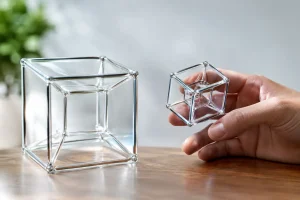
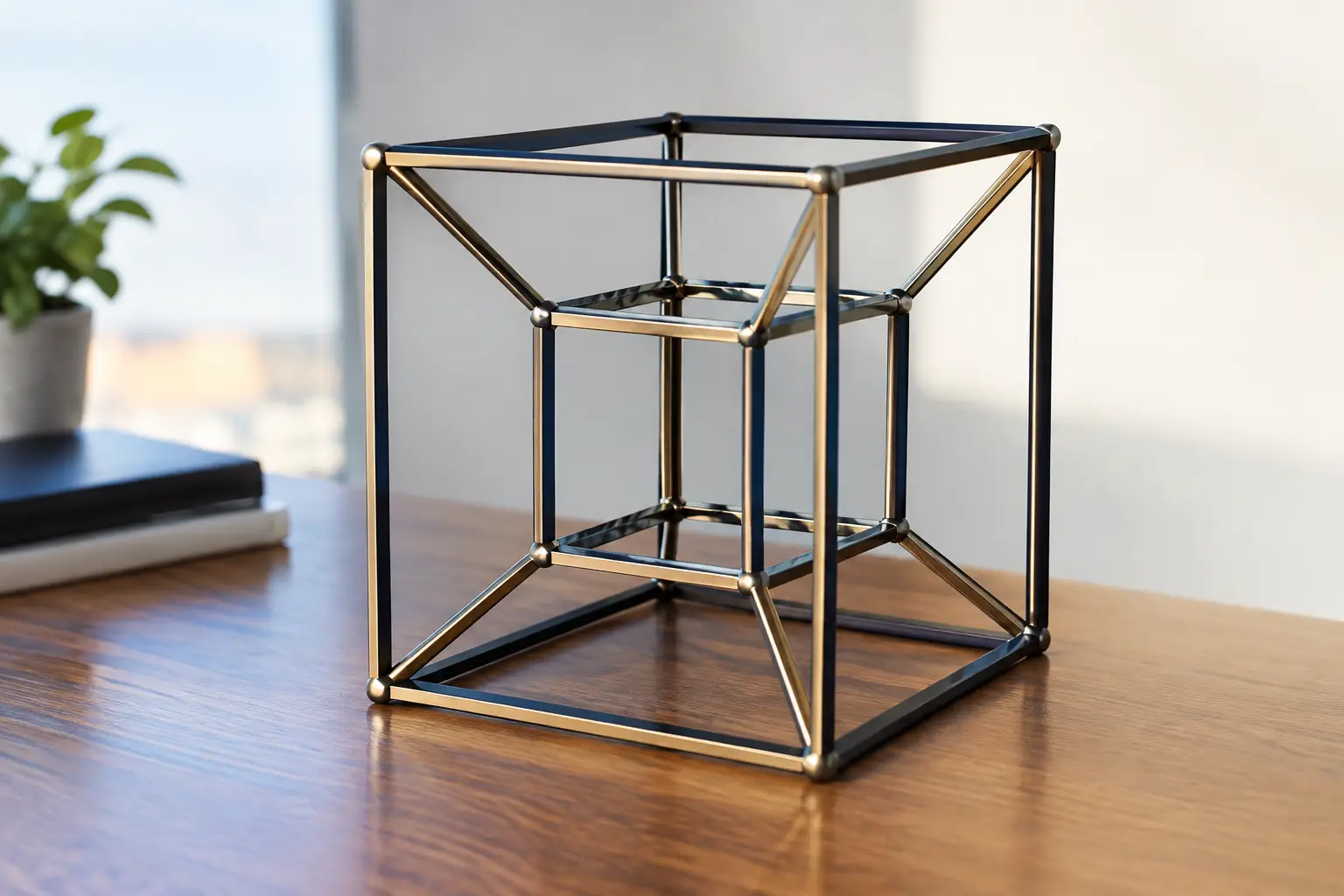
A cube is already a strange object when it arrives as a shadow on paper. Higher dimensions explained begins with that simple fact: an object can be completely real in its own space while appearing distorted, fragmented, or impossible when projected into a lower one. A tesseract is not a fantasy cube. It is the four dimensional analogue of a cube, governed by clean mathematics, yet difficult to picture because human vision evolved inside three spatial dimensions.
I build hyperdimensional sculptures because that gap between mathematical certainty and sensory uncertainty is fertile territory. Mirrors, reflected light, programmed color, and precise spatial geometry can make a viewer feel that a finite structure has opened into impossible depth. The experience is not proof that a fourth spatial dimension is hiding behind the glass. It is something more honest and perhaps more compelling: a physical encounter with the limits of perception.
Higher Dimensions Explained Begins With Coordinates
A dimension is not a mystical layer stacked above reality. In mathematics, it is an independent direction needed to locate a point. On a line, one number is enough. A point can sit at position 3 or position negative 2. That is one dimension.
On a flat plane, one number no longer suffices. You need two coordinates, usually called x and y. Move left or right, then forward or back. This is two dimensional space. Add height, the z coordinate, and you have the three dimensions of ordinary room space.
A fourth spatial dimension would require one more independent coordinate. Physicists and mathematicians often label it w. A point in four dimensional space could be described by four numbers: x, y, z, and w. The challenge is not that the math fails. The challenge is that no human eye can look directly along the w direction, because our bodies and visual systems occupy three spatial dimensions.
Time is often called the fourth dimension in relativity. That usage is valid, but it describes spacetime, where time has different physical properties from the three directions of space. When artists and geometers discuss a tesseract, they usually mean a fourth spatial dimension, an additional direction analogous to left and right or up and down. Keeping those two ideas distinct prevents a great deal of confusion.
What a Tesseract Is, Mathematically
Geometry gives each dimension a recurring family of shapes. A point can extend in one direction to form a line segment. Move that segment in a new perpendicular direction and it becomes a square. Move the square in another new perpendicular direction and it becomes a cube.
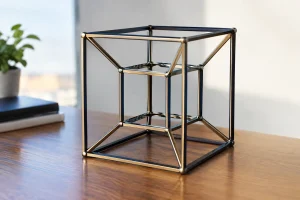
Continue the pattern once more. Move every point of a cube through a new direction, perpendicular to all three familiar directions, and the swept volume is a tesseract. It has 16 vertices, 32 edges, 24 square faces, and 8 cubic cells. Those eight cells are the tesseract’s equivalent of the six square faces of a cube.
The sequence is unusually elegant. A line segment has 2 endpoints. A square has 4 vertices. A cube has 8 vertices. A tesseract has 16 vertices. Each new dimension doubles the number of vertices because the shape contains the original form and a translated copy, joined along a new direction.
That description is exact, even if the form remains hard to imagine. Mathematics does not require visualization to be legitimate. Yet visualization can still reveal something meaningful, especially when it acknowledges its own limits.
Projection Is the Bridge Between Worlds
A three dimensional cube can cast a two dimensional shadow. Depending on the angle, that shadow may look like a square, a hexagon, or a skewed arrangement of lines. None of these drawings is the cube itself. Each is a projection, a translation from a higher dimensional object into a lower dimensional surface.
A tesseract can be projected into three dimensions in the same way. The familiar image of a small cube nested inside a larger cube, connected at corresponding corners, is one projection. It is not a tesseract floating in ordinary space. It is a three dimensional map of a four dimensional object, much as a cube drawing on a page is a map of a three dimensional object.
Rotation makes the idea more vivid. When a cube rotates, its two dimensional shadow changes shape. A rotating tesseract would create a three dimensional projection that appears to pass through itself, expand, contract, and invert. These transformations look impossible only because the missing w direction has been compressed into the projection.
This is where art can become an instrument of thought. A sculpture cannot literally contain a fourth spatial axis. It can, however, choreograph projections, reflections, and viewpoints so the mind keeps reaching for an extra direction it cannot quite grasp.
Why Recursive Reflection Feels Like More Space
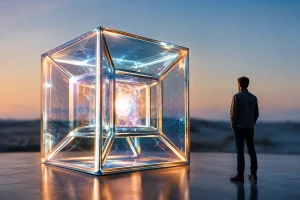
An infinity mirror structure creates repeated images between reflective surfaces. The actual physical depth may be measured in inches or feet, but the eye receives a chain of receding copies. The result is an apparent corridor that seems to continue far beyond the object’s boundaries.
That perceptual effect matters because spatial understanding is not built from geometry alone. The brain estimates depth from parallax, overlap, scale, focus, motion, and reflected patterns. When these cues agree in unusual ways, a compact object can feel vast. When they contradict one another, the viewer may feel suspended between the known room and an interior space that has no stable end.
In my Tesseract sculptures, the geometry establishes a rigorous frame. The mirror system multiplies that frame into recursion. Programmable color and temporal sequences shift the apparent boundaries, so the work becomes interactive even when a viewer is standing still. A small change in position can cause edges to align, split, or appear to extend through one another.
The sensation is not merely visual spectacle. It is a perceptual question made physical: if the senses report depth where the hands know there is a surface, which version of space feels more convincing?
Sacred Geometry, Without Escaping Mathematics
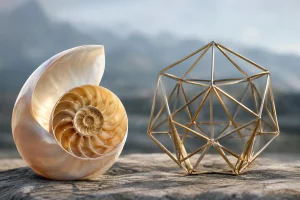
Sacred geometry often names the emotional charge people feel in symmetry, proportion, recursion, and repeated form. That response is real. Humans are pattern seeking organisms, and certain arrangements can produce calm, awe, or an almost dreamlike recognition.
But the geometry does not need inflated claims to be profound. A tesseract is compelling because its structure is exact. Reflection is compelling because light follows comprehensible physical rules. Symmetry can feel transcendent while remaining measurable.
I am interested in the point where these languages meet. A viewer may arrive with memories of lucid dreams, visions of infinite corridors, or the sensation that a familiar place has suddenly become much larger than itself. Mathematics offers another vocabulary for that experience: dimensional projection, recursion, symmetry group, coordinate system. Neither vocabulary cancels the other. Together, they make the encounter richer.
The Fourth Dimension at a Festival
At Burning Man and other immersive gatherings, scale changes the social meaning of geometry. A tesseract encountered alone on a screen is an idea. A large mirrored hypercube encountered at night, surrounded by dust, music, movement, and strangers, becomes a shared event in perception.
People circle it, test its edges, search for their own reflections, and watch other bodies repeat into apparent distance. The work becomes interactive through movement and attention. No two viewers stand at exactly the same coordinate, so no two viewers receive exactly the same spatial composition.
Augmented reality extends that question virtually. With an interactive headset experience, a participant can step inside structures that cannot be built at full physical scale. The virtual interior does not replace the sculpture. It changes the terms of encounter, allowing the body to compare physical boundaries with an expanded hyperdimensional environment.
For event producers, that distinction matters. An immersive installation is not simply an object placed in a field or room. It is a site where curiosity becomes collective behavior. People gather because they see others trying to understand what they are seeing.
What Higher Dimensions Do Not Require You to Believe
Higher dimensional geometry does not establish that hidden spatial dimensions are accessible through meditation, dreams, or mirror sculpture. Physics does entertain theories with additional dimensions, including models in which they are compactified at scales far beyond direct observation. Those ideas are serious areas of theoretical inquiry, but they are not confirmed by the feeling of looking into infinity.
Still, altered perception has value without becoming evidence. Lucid dreams can make a room rearrange itself with absolute conviction. Reflections can multiply a finite space until it feels bottomless. A tesseract projection can persuade the eye that inside and outside have traded places. Such experiences reveal how actively the mind constructs reality from incomplete information.
That is the invitation I find most compelling. Stand before a finite structure, follow its edges until certainty starts to bend, and let the mathematics remain precise even as the experience becomes strange. The fourth dimension may not become visible, but your assumptions about what it means to see space can become wonderfully less fixed.