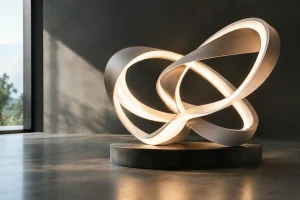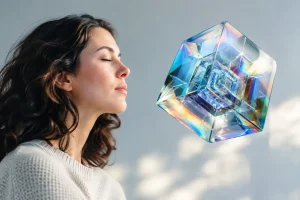
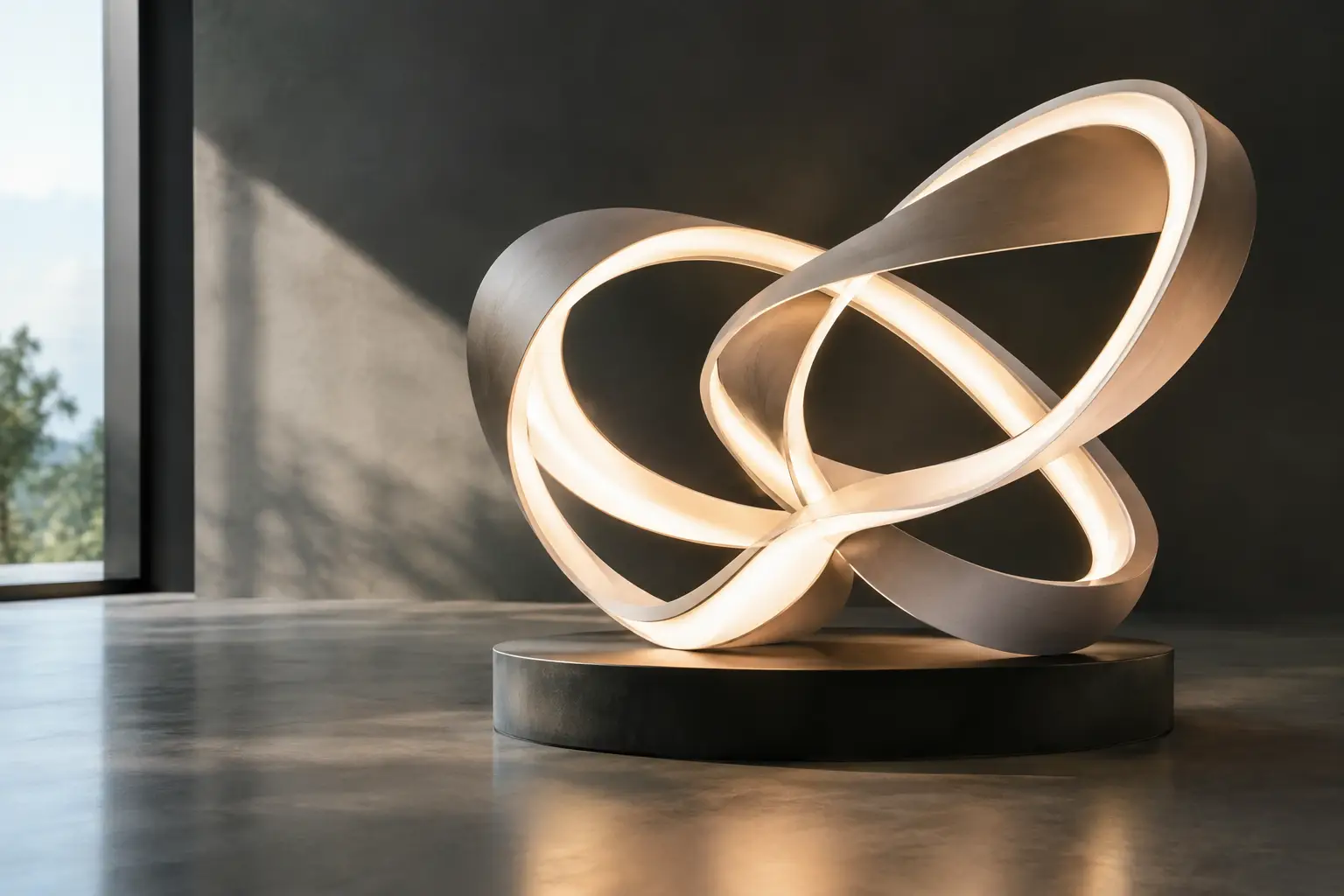
A mirror can turn a few feet of physical space into a corridor that seems to have no final wall. Stand before it long enough and your visual system begins to argue with itself. The surface says object, the reflections say distance, and the body feels pulled toward an elsewhere that cannot exist. This is where I begin with light as a sculptural material: not as something that reveals an object, but as the force that constructs the object in perception.
My sculptures ask a direct question. If the fourth dimension could only be encountered through a three dimensional projection, what would it feel like? A tesseract is not a mystical symbol or a piece of speculative fiction. It is the four dimensional analogue of a cube. Yet its complete form cannot be held in ordinary space any more than a cube can be fully held within a flat drawing. What can be built is a translation, an engineered situation in which reflection, repetition, color, and spatial geometry make the mind reach beyond the room.
Light as a Sculptural Material Changes the Boundary
Traditional sculpture begins with mass. Stone resists the chisel, metal remembers the heat that bent it, wood carries a grain. The physical structure of my work matters just as much. It establishes the geometry, holds the mirrored planes in precise relation, and gives the piece a real scale that the body can measure.
But mass is only the first boundary. When a geometric frame contains reflective surfaces, the apparent volume no longer ends at its exterior. Repeated reflections create a visual recursion, a sequence in which one illuminated edge appears again and again, smaller and farther away. The eye reads this cascade as depth. The brain knows, or thinks it knows, how parallel lines recede and how light behaves across a room. The sculpture uses those assumptions against certainty.
This distinction matters. An image of infinity is not the same as an encounter with apparent infinity. A flat image offers the eye a representation. An immersive mirror sculpture gives the viewer parallax, scale, and a shifting point of view. Move a few inches, and the geometry reorganizes. Lean closer, and the vanishing corridors seem to answer. The work becomes interactive before any device is introduced, because the viewer’s body is already part of the optical system.
The Tesseract Is a Map of a Higher Dimension
A useful way to understand the tesseract is to build dimensions one at a time. A point has no length. Move it through a new direction and it traces a line. Move the line perpendicular to itself and it traces a square. Move the square in a direction inaccessible to its own plane and it traces a cube.
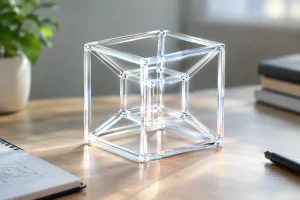
The next step follows the same logic. Move a cube in a direction perpendicular to all three of its existing axes and it traces a tesseract, also called a hypercube. Mathematics can describe this cleanly. A tesseract has 16 vertices, 32 edges, 24 square faces, and 8 cubic cells. The difficulty is not the mathematics. The difficulty is that human perception evolved to navigate three spatial dimensions, not to inhabit four.
A familiar wireframe image of a tesseract, a small cube joined to a larger cube by connecting edges, is a projection. It is analogous to drawing a cube as two offset squares on paper. The drawing is not the cube itself. It is evidence of the cube after dimensional information has been compressed.
My interest is in making that compression felt. The Tesseract uses a cubic framework and recursive reflection to produce an interior whose scale cannot be trusted. The visible geometry is disciplined, not arbitrary. Every edge is a cue, every repeated plane is part of a spatial proposition. The mind sees a cube, then sees cubes inside cubes, then begins to wonder whether the original object is a cross section of something larger.
Reflection Makes Physics Feel Impossible
Nothing supernatural is required for this effect. It begins with the simple law of reflection: the angle at which light arrives at a surface equals the angle at which it leaves. Mirrors preserve directional information with remarkable fidelity. Place reflective planes opposite one another, introduce a controlled illuminated form between them, and the form repeats through successive bounces.
Each reflection is less intense than the previous one because no real mirror returns every photon. That gradual loss is essential. It creates falloff, and falloff creates the perceptual signature of distance. The repetitions dim as they appear to recede, even though the entire phenomenon is contained within a finite structure.
Color changes the emotional physics of the experience. A deep blue field can feel cold, astronomical, almost oceanic. Magenta can turn the same geometry into a lucid dream. Warm tones can make the corridor feel inhabited rather than remote. These are not merely aesthetic changes. Color affects contrast, perceived distance, afterimages, and the speed at which the eyes adapt. In an interactive installation, programmed shifts can make a stable structure feel as if it is breathing, rotating, or opening.
The tradeoff is precision. Recursive optical work is unforgiving. A small misalignment can fracture the illusion, creating competing reflections where the eye expects continuity. Too much brightness can flatten depth. Too little can erase the structural logic. The craft lies in balancing physical materials, reflective angles, color, and viewing distance so the apparent impossible space remains coherent.
Why the Body Believes Before Language Does
Human perception is not a camera recording facts. It is an active prediction engine. The brain continuously combines sensory input with learned expectations about scale, motion, gravity, and enclosure. Most of the time, this is efficient. It lets us catch a falling cup and judge a stairway in low light. Inside an infinity mirror, those predictions meet evidence they cannot fully reconcile.
That moment of mismatch is the work. The eyes report depth, while the body remains only inches from a surface. A reflected version of the viewer appears far away, then multiplies into a procession of selves. The experience can be disorienting, but it can also be clarifying. It reveals that ordinary reality is not delivered whole to consciousness. It is assembled.
Lucid dreams offer a related sensation. In a lucid dream, the dreamer recognizes that an environment is constructed while continuing to inhabit it. The recognition does not necessarily make the experience less vivid. Sometimes it makes every color, hallway, and impossible transition more intense. An immersive sculpture can create a waking version of that threshold, a place where the viewer sees the rules and still feels their power.
Interactive Geometry at Festival Scale
At Burning Man and other immersive events, the context changes the sculpture. A gallery visitor may approach deliberately, with time to inspect the frame and test the reflections. On the playa or in a festival field, someone may find the work after hours of walking, music, dust, conversation, and sensory overload. The tesseract arrives less like an object and more like a spatial event.
Large scale installation makes room for collective perception. One person may see a portal, another a mathematical proof made physical, another a memory of a dream they cannot name. People gather around it, photograph it, circle it, and return later under different conditions. The sculpture remains interactive because every movement changes the projection, but the crowd adds another layer. Each observer becomes a reflected figure inside the geometry of everyone else.
Augmented reality extends this encounter without replacing the physical work. With a headset, viewers can virtually step inside the sculpture and experience its spatial logic from a viewpoint impossible for the body outside it. This interactive layer is not a substitute for material presence. It is another projection, one that lets the architecture of the hypercube unfold around the viewer and makes the question of inside versus outside even less stable.
Building an Encounter With the Unseen
I do not treat sacred geometry as a code that guarantees hidden truths. Its power comes from something more tangible: proportion, symmetry, repetition, and the human urge to find order in complexity. Geometry can be rigorous and still generate awe. A square is simple. A cube is simple. Their repeated, reflected, and projected forms can become overwhelming.
That is why light as a sculptural material is so potent. It lets a finite object carry an infinite proposition. It can make edges appear to continue past matter, make interior space exceed exterior dimensions, and make the familiar act of looking feel newly unreliable.
The next time a reflected corridor seems to open beneath your eyes, resist the urge to solve it too quickly. Let the physics be exact, let the geometry remain visible, and let perception keep its beautiful uncertainty. The fourth dimension may not be waiting behind the mirror, but the mind that looks into it is already larger than it was a moment before.