A tesseract does not become less strange because a machine can describe it. The phrase AI used for non AI art raises a useful question for artists working with mathematics, perception, and physical space: where does computation end, and where does authorship begin? For me, the answer begins with the object itself. A mirror sculpture, a geometric framework, reflected photons, a body moving through space, and the sudden sensation that a room contains impossible depth are not prompts. They are physical events.
AI can assist an artist without becoming the artist. It can help organize complex information, test language, identify patterns, or accelerate early research. But it cannot stand inside an installation at a festival, watch strangers hesitate at its threshold, or decide that a particular proportion creates the precise disorientation needed to make a hypercube feel present. Those choices emerge from material, geometry, perception, and lived encounter.
AI Used for Non AI Art Begins With a Clear Boundary
The phrase non AI art does not need to imply a rejection of every computational tool. Artists have long used tools that extend calculation beyond what can be held in the mind at once. Perspective systems, camera obscuras, computer aided modeling, parametric equations, and projection studies all expand the ability to imagine form. None of them removes the artist from the work when the artist remains responsible for the questions, constraints, selections, and physical construction.
The meaningful distinction is not whether a machine touched part of the process. It is whether the final artwork is authored through intention and embodied craft, or whether its central visual decisions have been outsourced to a model trained on vast collections of other people’s images.
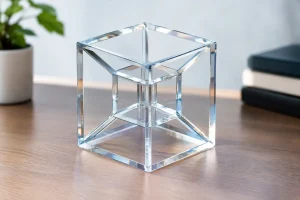
A tesseract installation is a useful test case. The tesseract is the four dimensional analogue of a cube. A square has four edges, a cube has six square faces, and a tesseract has eight cubic cells. Human vision cannot directly see four spatial dimensions, so any sculpture that attempts to evoke one must translate rather than reproduce. The translation depends on rigorous choices about projection, scale, reflection, transparency, repetition, and movement.
AI may be able to return an image that resembles an impossible cube. That is not the same as building a three dimensional structure whose recursive reflections persuade the body that it is witnessing a space beyond ordinary depth. One is an image. The other is a perceptual experiment.
The Physical World Is Not a Prompt
My Tesseract sculptures begin with mathematics, but mathematics alone does not produce the experience. Equations can establish relationships between vertices, axes, angles, and projected forms. They can reveal how a higher dimensional figure might cast a lower dimensional shadow. The actual sculpture then has to negotiate materials and human perception.
Mirrors do not merely repeat an image. Their placement determines which paths reflected light can take, how depth appears to multiply, where the viewer’s body enters the composition, and when the structure seems to open into infinity. A minute shift can make a form feel coherent, flat, unstable, or cosmically deep. These outcomes are discovered through building, observing, rebuilding, and observing again.
That feedback loop is where non AI art remains insistently alive. A physical installation has resistance. Surfaces have tolerances. Reflections have angles. Space contains distractions, weather, sound, dust, darkness, and thousands of moving people. At Burning Man and other immersive gatherings, the piece is never experienced in a vacuum. It becomes interactive because visitors bring their own motion, attention, exhaustion, curiosity, and altered sense of scale.
No image model can fully anticipate what happens when someone approaches a hyperdimensional mirror form at night, catches sight of an apparent corridor where there is none, then realizes their own reflection has become part of the geometry. That moment is not simply visual. It is spatial and psychological. It resembles the logic of a lucid dream, where the familiar remains recognizable while the rules beneath it become unstable.
Where AI Can Be Useful Without Taking the Center
There are legitimate, limited uses for AI in an art practice built around real objects. It can help translate a dense technical note into plain language, compare approaches to a mathematical problem, sort early research themes, or generate questions that expose an overlooked assumption. For an artist preparing a large interactive installation, it may also help structure planning information or explore several verbal descriptions of an intended experience.
These uses are most valuable when they remain subordinate to judgment. AI is good at producing plausible associations quickly. It is far less reliable as a source of truth, especially with advanced mathematics, physics, cultural history, or specialized fabrication questions. It can state a confident falsehood with elegant phrasing. That makes verification essential.
The tradeoff is clear. Used carefully, AI may reduce clerical friction and create space for more experimentation. Used carelessly, it can flood a practice with generic images, borrowed aesthetics, and language that sounds meaningful without being anchored in a real idea. The faster an artist can generate options, the more discipline is required to recognize which options are empty.
For work concerned with the fourth dimension, this matters deeply. Higher dimensional geometry is already vulnerable to visual shorthand. A glowing cube, a spiral, or a field of fractal texture can suggest mystery, but suggestion is not understanding. I am interested in the more difficult task of making viewers feel the consequences of a geometric idea through their own bodies. The aim is not to decorate a concept with futuristic imagery. The aim is to build a situation in which perception has to work differently.
Authorship Is a Chain of Decisions
An artwork is not only its final appearance. It is the chain of decisions that makes that appearance inevitable. Why this geometry rather than another? Why this proportion? Why should the viewer stand here? What does the reflected recursion reveal about the limits of three dimensional perception? What must be removed so that the essential form can speak?
Those decisions are inseparable from responsibility. An artist can use a computational system and still retain authorship when the system is one instrument within a deliberate process. But authorship becomes thin when an artist cannot explain the source, structure, or purpose of what has been produced.
This is also an ethical question. Systems trained on uncredited creative work can obscure the labor and visual language of countless artists. A studio that values originality should not treat that history as raw material without consequence. Research, references, and influences have always shaped art, yet there is a difference between studying a lineage and asking a machine to imitate its surface at scale.
For event producers and curators, the distinction is practical as well as philosophical. An experiential installation must survive contact with reality. It must invite movement, reward repeated viewing, and hold its conceptual integrity amid a crowd. The value lies in the encounter, not only in an image used to announce it.
AI Cannot Replace the Shock of Recognition
A hypercube is not mystical because it is incomprehensible. It is compelling because it reveals a hard fact about perception: human intuition was shaped for a particular slice of reality. A four dimensional object can be defined with precision, yet it cannot be fully pictured by a mind evolved to navigate three spatial dimensions. That gap between what can be calculated and what can be sensed is fertile artistic ground.
AI can participate at the edges of that exploration, as a research assistant, a language tool, or a way to surface possibilities that still require testing. It should not be confused with the encounter itself. The encounter occurs when a person sees a finite sculpture produce apparently infinite space, then feels their certainty about the room quietly loosen.
That is the standard I return to: not whether a tool appears advanced, but whether it helps make the impossible more physically, intellectually, and emotionally real.