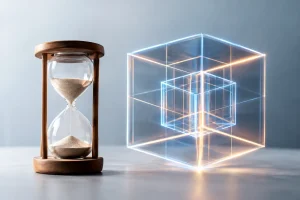

A person can stand inside a mirrored cube and feel depth multiply beyond the reach of the room. The immediate intuition is often that this must be the fourth dimension. But fourth dimension versus time is not a small semantic disagreement. It is the difference between a geometric direction that human bodies cannot enter and the temporal condition through which every human body already moves.
That distinction is central to how I think about the Tesseract. A hypercube is not a metaphor for time, nor is time simply another hallway extending at right angles to left, right, up, down, forward, and back. Both ideas are profound. They are also different, and the gap between them creates a fertile space for art, physics, and altered perception.
Fourth Dimension Versus Time in Physics
A dimension is, at its most practical, an independent coordinate needed to locate an event or object. A point on a line needs one number. A point on a plane needs two. A point in ordinary space needs three, commonly called length, width, and height. If there were a fourth spatial dimension, a point in that space would require one more independent number.
Time enters physics differently. In Einsteinian relativity, an event is specified with three spatial coordinates and one time coordinate. Together they form spacetime. This is why time is often called the fourth dimension, and in a specific mathematical sense that statement is correct.
Yet time has properties that set it apart from a spatial direction. The equations use a different sign for time in the spacetime interval, a detail with enormous consequences. Spatial displacement and temporal separation are not interchangeable in the way moving east can be exchanged with moving north after rotating a map. A person may turn around in space. A person cannot simply rotate into yesterday.
Causality also gives time its strange authority. Causes and effects are constrained by the speed of light. Relativity changes how observers measure duration and simultaneity, but it does not turn time into a corridor one can stroll through as freely as a gallery. Calling time a dimension should not erase this asymmetry.
There is still room for debate at the edges. Physicists differ in how they interpret the passage of time, and philosophers argue over whether the future is as real as the present. Those questions are not settled by a single equation. But the geometry of spacetime and the geometry of a four spatial dimensional hypercube remain distinct constructions.
A Tesseract Is Four Spatial Dimensions
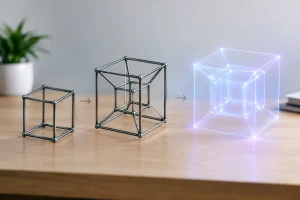
A square is built from four line segments. A cube can be imagined by moving a square through a third spatial direction, then connecting corresponding corners. Extend that same logic once more, moving an entire cube through a new direction perpendicular to all three familiar axes, and the result is a tesseract, also called a four dimensional hypercube.
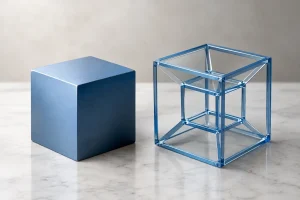
A tesseract has 16 vertices, 32 edges, 24 square faces, and 8 cubic cells. That last phrase is the part that resists ordinary intuition. Just as a cube is bounded by six square faces, a tesseract is bounded by eight cubes. Human vision cannot take in those cubic cells directly because eyes and hands operate inside three spatial dimensions.
Projection is the bridge. A three dimensional cube can cast a two dimensional shadow that looks like a skewed square inside another square, connected at the corners. In the same way, a tesseract can be projected into three dimensions as a cube within a cube, joined by edges. The familiar wireframe image is not the tesseract itself. It is a translation, carrying some relationships across dimensions while distorting others.
This is not a failure of the image. It is the point. Every projection asks what survives when a higher dimensional structure enters a lower dimensional world. Lengths change. Angles change. Parts overlap. Interior and exterior become difficult to separate. A projection gives perception a clue, then makes perception work for the rest.
Why the hypercube feels impossible
The tesseract feels impossible because intuition is trained by embodiment. A hand learns space through grasping. Vision learns it through parallax, occlusion, and motion. The brain becomes exceptionally good at reconstructing three dimensional environments from partial information, yet it has no direct sensory history of motion along a fourth spatial axis.
A hypothetical four dimensional being would encounter a cube in ways that sound like magic to us. It could inspect every point inside a sealed box without opening it, just as a three dimensional person can see the whole interior of a flat drawn square. It could remove an object from a closed three dimensional container without crossing the container’s walls, by moving it through the extra direction.
These thought experiments do not prove that extra spatial dimensions exist at a human scale. They clarify what the mathematics means. Geometry can be real as a structure of reasoning without being an accessible place to visit.
Building a Projection You Can Feel
My sculptures begin with this constraint, a tesseract cannot be physically built in four spatial dimensions here. What can be built is an encounter with projection, recursion, and the sensation that the visible room has failed to contain the object.
Mirrors create a particularly powerful translation because reflection repeats a spatial relationship while withholding a final boundary. An illuminated frame placed between reflective surfaces appears to recede into a sequence of nested volumes. The eye reads each repetition as depth, even though the physical structure remains finite. The result is not an infinite object. It is a finite machine for producing the perception of infinity.
That distinction matters to the craft. The position of each plane, the reflectivity of each surface, the spacing of the frame, and the programmed color sequences all change the apparent geometry. A few millimeters can shift whether a form appears stable, tunnel like, or uncannily open. The sculpture becomes interactive because the body completes the projection. A small change in viewpoint can cause edges to align, split apart, or reveal another apparent chamber.
In an interactive augmented reality activation, a viewer can virtually step inside an interpretation of the form. This does not claim to transport anyone into a literal fourth spatial dimension. It offers a different perceptual experiment: what happens when scale dissolves, familiar coordinates lose their certainty, and the body becomes a moving reference point inside a geometric idea?
Sacred Geometry, Without Pretending It Is Physics
Sacred geometry has an enduring pull because symmetry feels both visual and philosophical. Repeated proportions, nested solids, radial structures, and tessellations can produce a sense of order that arrives before language. They appear in architecture, ornament, crystallography, biological forms, and mathematical study.
That resonance should not be confused with scientific evidence for hidden cosmic messages. A tesseract is compelling because its combinatorial structure is precise, not because it needs mystical decoration. At the same time, precision does not make an experience emotionally sterile. The clean logic of a hypercube can create awe precisely because it exposes the narrowness of ordinary perspective.
For me, spatial geometry is most alive when it remains double edged. It can be measured, modeled, and engineered. It can also unsettle the observer enough to resemble a lucid dream, where a familiar room suddenly has one too many corners and an impossible passage feels perfectly natural.
Time, Dreams, and the Festival Body
At Burning Man and other large scale immersive events, time becomes elastic in a more human sense. A night can feel compressed into a few vivid images, or a few minutes inside an installation can feel strangely extended. Music, darkness, movement, heat, exhaustion, conversation, and the presence of strangers all alter attention. This is psychology and physiology, not evidence that a tesseract has opened in the desert.
Still, altered attention can make geometric questions land with unusual force. When thousands of people encounter an interactive sculpture, some see pure mathematics. Some see a portal. Some simply stop, laugh, and walk around it again because their visual system refuses to settle on a single explanation. All of those responses begin with a real perceptual event.
The fourth dimension may be time in the language of spacetime. It may be an additional spatial coordinate in the language of hypercubes. Neither meaning needs to defeat the other. The more interesting question is what happens when a carefully built projection lets the mind feel the difference, then leaves a small, bright uncertainty where certainty used to be.